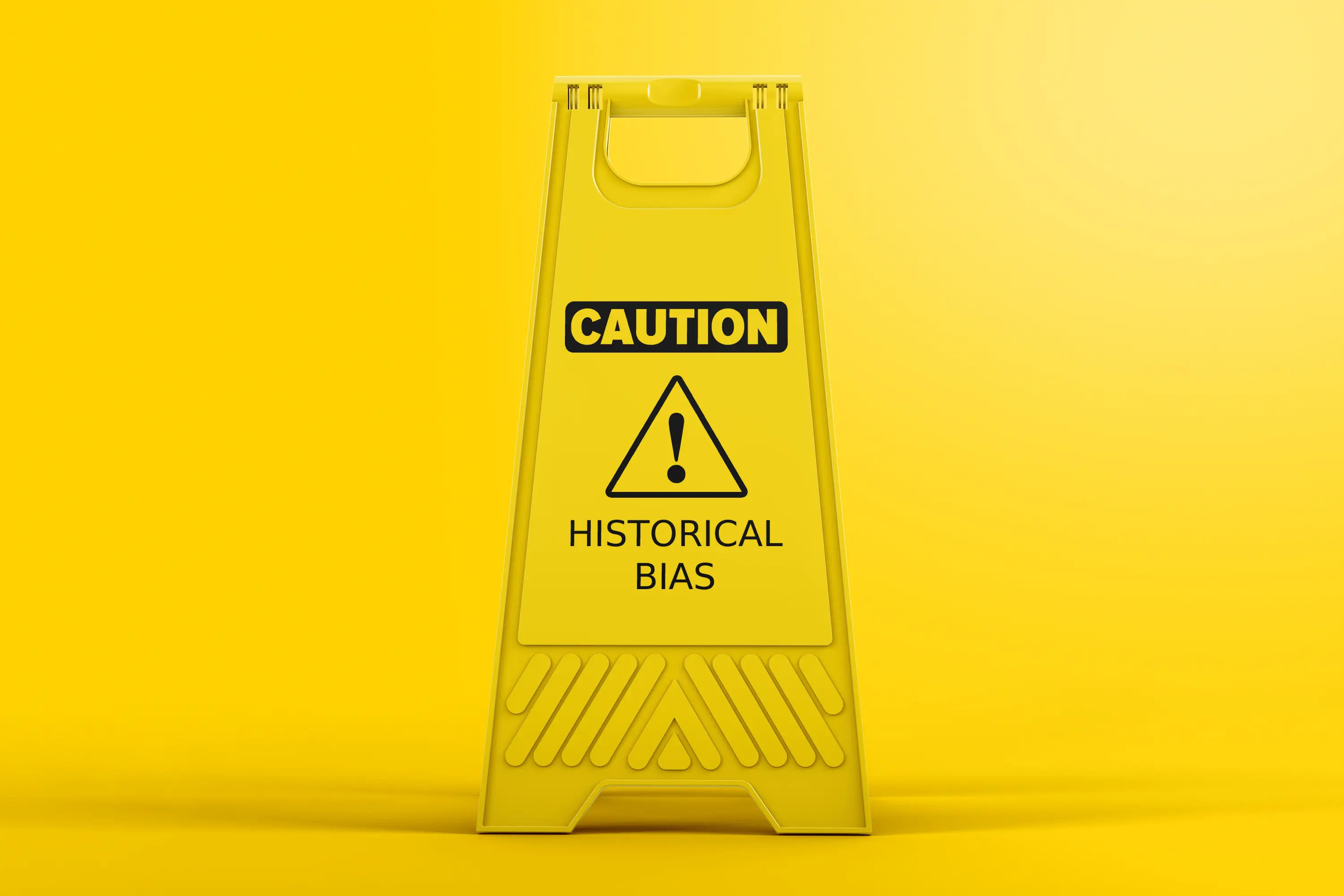
It is a common misconception that AI is a cold, hard truth-teller. In reality, AI is more like a very fast, very confident intern who spent all night reading a library that has not been updated since 1950. It does not just "calculate" — it mirrors the messy, biased world we have documented in our data. The model did not invent the bias. It learned it, scaled it, and handed it back to you formatted as an insight.
We touched on this in our article on digital literacy and AI bias — specifically in the context of hiring tools and the importance of having digitally literate humans in the loop. But identifying these patterns in your own workflows requires a deeper look at the specific forms bias takes. If you are using AI for hiring, writing, performance evaluation, or data analysis, these biases are not rare technical glitches. They are invisible coworkers showing up to every meeting, influencing every output, and never once putting their name on anything.
None of the examples below represent AI "going wrong." They represent AI doing exactly what it was designed to do — find patterns in historical data and apply them to new situations. The problem is that historical data is not neutral. It reflects the world as it was, not necessarily as it should be. That distinction is what AI bias is built on.
Historical bias occurs when training data reflects past societal patterns and inequalities — and the model faithfully reproduces them. The AI is not broken. It is doing exactly what it was built to do: optimise based on what historically led to success. The problem is that "what historically led to success" was shaped by structural inequalities that have nothing to do with actual capability.
In practice, this means AI systems identifying "top talent" or "ideal customers" based on patterns from a world that looked very different from today's. The model has no way of knowing that the patterns it learned were themselves the product of unequal access, not unequal ability.
Large language models are trained predominantly on text that reflects dominant language norms — standard English, formal corporate register, the kind of writing that fills published books, academic papers, and professional documentation. This creates a model that rewards a particular style of communication and treats deviations from it as deficiencies, even when those deviations are simply different, not inferior.
Non-native speakers, people who communicate in more direct or informal registers, and professionals whose first language shapes how they construct written English are all disadvantaged by this. The model is not evaluating the quality of their thinking. It is evaluating the degree to which their writing resembles the dominant pattern it was trained on.
AI systems optimise for what they can measure. When the metric used to represent success is a flawed proxy for what actually matters, the model faithfully optimises for the wrong thing — and does so at scale, consistently, without ever flagging that anything is amiss. The technical performance looks fine. The real-world outcomes are systematically distorted.
This is one of the most insidious forms of bias because it is the hardest to spot from inside the system. Everything is working as designed. The outputs look reasonable. The bias is entirely in the question the model was asked to answer — and no amount of model improvement will fix a fundamentally flawed proxy.
Automation bias is distinct from the other entries on this list because it is not a flaw in the model — it is a flaw in how people respond to models. Humans have a well-documented tendency to over-trust automated systems, deferring to their outputs even when those outputs conflict with their own judgment or expertise. The more authoritative the system appears, the stronger the effect.
In professional contexts, this manifests as AI-generated reports being approved without review, AI-assisted recommendations being accepted without scrutiny, and errors that a trained professional would ordinarily catch being missed because the presence of an AI output shifts the cognitive frame from "evaluate this" to "confirm this." The HITL control only works if the human in the loop is actually exercising judgment rather than rubber-stamping a machine's output — a distinction that automation bias directly undermines.
When an AI system is trained on data that does not reflect the diversity of the real world, it performs well for the groups that were well-represented in that data — and poorly, or harmfully, for everyone else. Underrepresented groups become edge cases in a model that was never designed with them in mind, and the outputs the system produces treat majority patterns as defaults and everything else as exceptions.
For organisations using AI to generate marketing materials, customer insights, or audience-facing content, this form of bias has direct reputational and commercial consequences. A model that defaults to a narrow demographic when generating imagery, copy, or recommendations is not serving your actual audience — it is serving a statistical abstraction of who your audience used to be, or who was overrepresented in whatever data the model was trained on.
All of the above are forms of bias your team is navigating every day — in hiring decisions, in performance reviews, in marketing assets, in clinical or financial recommendations, in the reports that get signed off and acted on. Most of them go unnoticed, not because they are subtle, but because the people reviewing AI outputs were never given the framework to recognise them.
That is a training problem. And it is a solvable one.
Our AI literacy courses cover the practical skills your team needs to identify, challenge, and manage AI bias in real workflows — not just in theory, but in the tools they use every day.
Explore AI Literacy Courses →