AI adoption is accelerating across almost every sector. The tools are more capable than they were six months ago, the regulatory landscape is shifting, and your employees are reading headlines about automation replacing their jobs — while you are trying to figure out how to actually lead through all of it.
Leadership has never been the easiest role. AI has not made it any easier.
There is a persistent misconception about what leadership actually involves — the idea that it is mostly about making decisions while other people do the real work. Good leadership is, in fact, a great deal of work. And crucially, it requires at least a working understanding of everything your organisation does. You cannot delegate functions you do not understand. You cannot set direction without knowing what is feasible. You cannot evaluate performance without a reference point for what good looks like.
That has always been true. What is new is the scope of what leaders now need to understand. Digital literacy is no longer optional at the leadership level — and AI literacy is fast becoming part of that baseline. This is not about knowing which model is trending on a given week. It is about understanding enough to ask the right questions, make informed decisions, and lead the humans around you through a genuinely disorienting period of change.
The Questions Every Leader Is Now Sitting With
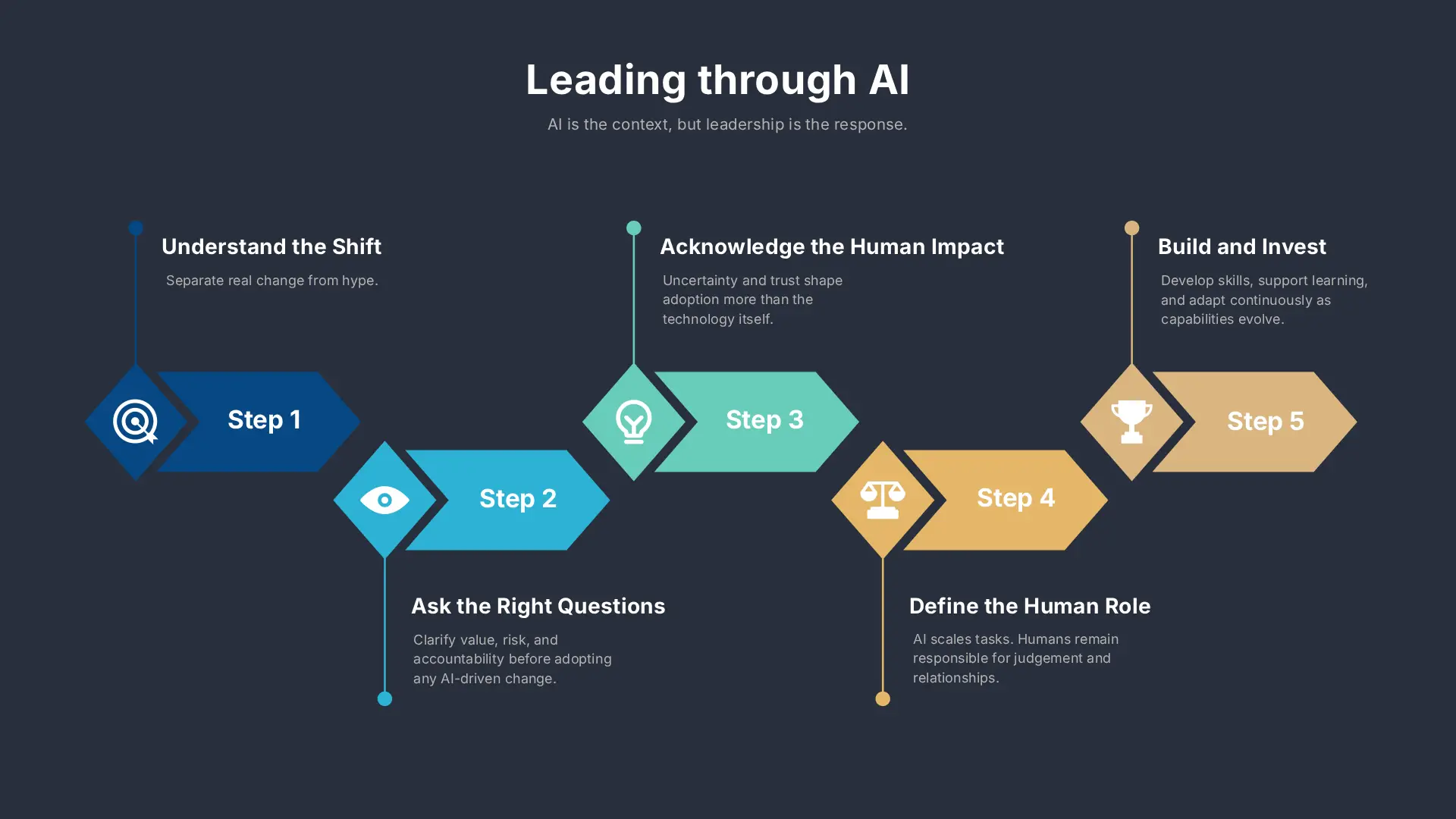
Even before you consider specific frameworks like GDPR or the EU AI Act — and the legal obligations they place on organisations deploying AI — there are foundational leadership questions that the rise of AI has made unavoidable. Leaders who have not yet engaged with these questions are already behind.
Leaders with genuine technological curiosity will have an advantage here. But even they will find the pace of AI development difficult to stay ahead of. The goal is not to become an AI expert. It is to build the organisational reflexes — the culture, the processes, the people — that allow your team to adapt as the technology continues to evolve.
Faith, Trust, and Sustainable Processes
One of the central leadership challenges of this moment is not technical. It is human. How do you continue to motivate and retain a team that is being bombarded with news headlines about AI replacing their jobs? How do you build trust in new workflows when employees are uncertain about where they fit in them? There is, of course, an entirely separate dimension to this — the external pressures that AI places on leadership: regulatory compliance, governance obligations, reputational risk, and the growing body of law that organisations must navigate as they deploy these tools. We cover that side of the picture here. But for now, this article focuses deliberately on the internal human aspect — the team dynamics, the motivation challenges, and the cultural work that leaders need to do from the inside out.
The truth is your best asset here. And the truth, examined honestly, is more reassuring than the headlines suggest. Even in scenarios where AI reduces the need for new hiring, organisations still need skilled people to synthesise, evaluate, and act on what AI produces. Even in the most optimistic projections for AI capability, most models — and most regulatory frameworks, including the EU AI Act — explicitly envision some form of Human-in-the-Loop (HITL) oversight for AI-generated outputs. The human is not being written out of the process. The human's role is being redefined.
There is also something AI simply cannot replicate, and it is worth naming directly: human connection. A good sales professional can build trust across a table, read the room, navigate an unexpected objection, and form a relationship that survives a difficult conversation. An AI model can be trained to simulate aspects of that — but it cannot build a genuine relationship, and it cannot be present in the way a person can. Many modern professional environments depend on exactly that presence. It does not disappear because the tools around it change.
This is why the AI conversation and the leadership conversation are not separate discussions. How you handle this moment — how transparent you are, how much you invest in your people's development, how you frame the change — will define your team's trust in your leadership long after the specific tools have been updated, deprecated, or replaced by the next iteration.
What AI Does Well — and Where People Still Win
- Processing and summarising large volumes of information quickly
- Drafting first versions of structured documents
- Identifying patterns in data
- Automating repetitive, rules-based tasks
- Providing 24/7 availability for defined, bounded queries
- Building trust and managing relationships
- Navigating ambiguous, high-stakes decisions
- Providing accountability and ethical oversight
- Reading context that isn't in the data
- Motivating, developing, and leading other people
The leaders who navigate this well will not be the ones who pretend the distinction does not exist, nor the ones who dismiss AI as overhyped. They will be the ones who are honest with their teams about both columns — and who invest deliberately in developing the skills that sit firmly in the right one.
Building a Learning Culture Around AI
Effective AI leadership does not require you to track every new model release or know whether your team is switching from one tool to another this week. What it does require is creating an environment where people feel safe to learn, safe to make mistakes, and supported in developing genuine competence over time.
That means building a learning culture — not as a values statement, but as an operational reality. Mistakes will happen as your team explores new tools. The question is whether those mistakes surface, get examined, and become learning — or whether they get hidden because the culture does not tolerate them.
Technology Is the Tool. Leadership Is the Test.
Despite the pace of AI development, one thing has not changed: technology is a tool, not a substitute for leadership. The organisations that emerge strongest from this period will not necessarily be those with the most advanced AI stack. They will be those with leaders who understood how to integrate new capabilities thoughtfully — who kept their people informed, invested in their development, and maintained the human foundations that make teams actually function.
The rise of AI is, in that sense, a leadership test as much as a technological one. How you respond to it — the culture you build, the transparency you model, the training you invest in — will define your team's experience of this transition and their capacity to navigate the next one.
A critical part of that response is structured learning. Good training helps your employees manage these new tools with confidence, and helps you as a leader frame the broader questions your organisation needs to work through. That applies both to AI literacy and to the leadership skills — conflict management, communication, change navigation — that this moment demands in equal measure.
We have a growing library of courses covering both the leadership skills to navigate this moment and the AI literacy your team needs to make the most of it. If you don't find exactly what you're looking for, we have the expertise to build it.