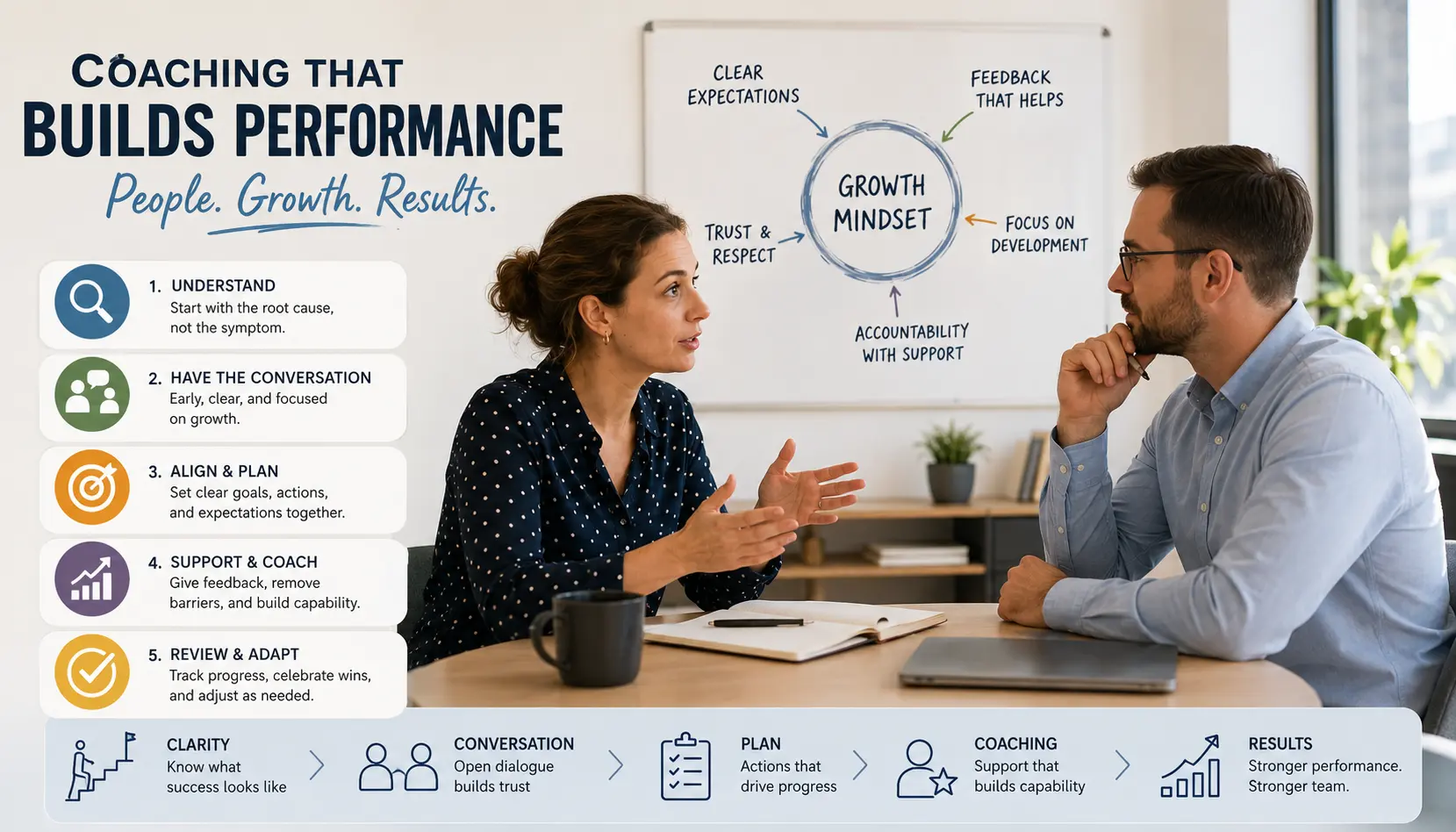
When an employee isn't performing, most managers do one of three things. They avoid the conversation. They have it too late. Or they skip coaching entirely and go straight to a formal process. None of these approaches works.
Nearly two-thirds of HR professionals report that fewer than half of the managers at their organisation effectively address underperformance among their direct reports. That's not because managers don't care. It's because coaching an underperforming employee is genuinely difficult — and most managers have never been taught how to do it well.
Done right, performance coaching is one of the highest-leverage things a manager can do. Organisations that focus on employee performance are 4.2 times more likely to outperform peers, with average revenue growth 30% higher and attrition five percentage points lower. The skill is worth developing. This guide covers the full process: how to identify what's actually causing the underperformance, how to have the conversation, how to build a plan that works, and how to know when coaching is no longer the right tool. It sits alongside the broader capability framing in what AI training managers need.
Start With the Root Cause, Not the Symptom
The most common coaching mistake is treating the visible symptom as the problem to solve. Missed deadlines, poor output quality, low engagement: these are signals that something else is wrong. Coaching that addresses the symptom without identifying the root cause produces temporary improvement at best and resentment at worst.
The root causes of underperformance fall into a small number of categories, and identifying which one you're dealing with determines everything that follows.
Before any coaching conversation, take time to honestly consider which category applies. Speak to colleagues, review any available data, and reflect on your own management. Unclear expectations and insufficient feedback are manager problems as often as they are employee problems. That's worth sitting with before the conversation, not discovering during it.
Have the Conversation Early
The single most damaging thing a manager can do with underperformance is wait. The longer a performance gap is left unaddressed, the more entrenched it becomes — for the employee, for the team watching it, and for the manager who now has a longer history of inaction to explain.
Early intervention doesn't mean an aggressive conversation. It means a timely one. A direct, private, and supportive conversation at the first sign of a pattern costs far less than a formal performance improvement process six months later. The math on that is obvious once you've lived through both.
The goal of the first conversation isn't to deliver a verdict. It's to open a dialogue. The primary aim at this stage is to create a space where the employee feels comfortable sharing honestly. That means opening with questions, listening without judgment, and only then sharing your observations. Schedule a private one-to-one specifically for this conversation. Don't raise performance concerns in passing, in a group setting, or at the end of a meeting about something else. Give it the space it deserves.
What to Say and How to Say It
The coaching conversation has a structure. Managers who improvise tend to either soften the message so much it doesn't land, or deliver it so bluntly that the employee becomes defensive. Neither produces the outcome you need. Four steps, in order.
Start by asking the employee how they feel things are going. Their answer tells you whether they're aware of the gap, whether there's a reason they haven't raised it, and how self-aware they are about their own performance.
"How are you finding the workload at the moment?" or "How do you feel the last few weeks have gone?"
"I need to talk to you about your performance."
When you do raise the concern, be concrete. Name the specific behaviours or outputs you've observed, with examples and dates where possible. Vague feedback lets the employee dispute the premise. Specific feedback gives both of you something to work with.
"In the last three weeks, the reports have come in late and the last two contained errors we had to correct before sending."
"Your work hasn't been up to scratch lately."
Before you state what you think the problem is, ask. "What do you think is getting in the way?" gives the employee the opportunity to surface the root cause themselves — and often produces information you didn't have. This isn't a rhetorical question. Listen to the answer. If they tell you they're overloaded, or that a colleague is blocking them, or that they've been struggling with something personal, that changes the intervention entirely.
The conversation should end with a clear, mutually agreed action. Not a lecture. What will change, how you'll both know it has changed, and when you'll next review it. Both parties should leave the room knowing what happens next. If the employee walks out unsure, the conversation didn't do its job.
Build a Coaching Plan, Not Just a PIP
A Performance Improvement Plan is a formal document used when coaching hasn't produced the required change and escalation is the next step. Many managers reach for a PIP too early — and in doing so, transform what could have been a supportive coaching relationship into an adversarial one.
A coaching plan is different. It's less formal, more collaborative, and designed to support rather than warn. A good coaching plan covers four things.
Here's the question worth sitting with before drafting a PIP: has the coaching plan actually been run? Have the goals been concrete, the support genuinely provided, the check-ins consistently held? If the honest answer is no, the escalation isn't fair — and it probably won't hold up to scrutiny either.
Common Mistakes That Undermine Coaching
Even managers who have the conversation early and build a plan can undermine their own coaching through predictable patterns. Four of them account for most failures.
Vague feedback. Telling an employee their attitude needs to improve, or that they need to be more proactive, without specifying what that looks like in practice, gives them nothing to act on. Effective coaching feedback is behavioural and observable. If you can't point to a specific example, the feedback isn't ready to be delivered.
Inconsistent follow-through. Setting a coaching plan and then missing check-ins, failing to review progress, or not acknowledging improvement sends the message that the plan wasn't serious. Employees read inconsistency as permission to revert. The manager who doesn't follow through has actively undermined the intervention they just ran.
Avoiding the difficult second conversation. If the first conversation doesn't produce change, the second one needs to be clearer about the stakes: what improvement is required, by when, and what the consequences of continued underperformance are. Many managers have the first conversation and then wait. The waiting is the mistake.
Coaching when training is needed. If the root cause is a skill gap, coaching alone won't close it. When an employee genuinely lacks the knowledge or capability to do something, targeted training is the more effective intervention. See building an AI literacy programme for a worked example of when skill gaps require a structured training response. Coaching and training are complementary tools, not interchangeable ones.
When Coaching Is No Longer the Right Tool
Coaching isn't appropriate in every situation, and recognising when to shift approach is as important as knowing how to coach well.
If an employee has received clear feedback, adequate support, and a realistic timeframe to improve — and hasn't improved — the appropriate next step is a formal performance management process. This transition shouldn't come as a surprise if the coaching plan has been run well. The goals were clear. The support was provided. The timeline was agreed. Moving to a formal process is the logical next step, not a sudden escalation.
There are situations where coaching isn't the primary intervention from the start. Misconduct is a disciplinary matter, not a coaching matter. Role misalignment is a structural question that needs addressing regardless of coaching outcome. And some personal circumstances require HR involvement, not a manager working through a coaching framework alone. The skill is recognising which situation you're actually in — not defaulting to coaching because it's the most comfortable tool.
When an employee is resistant to change despite adequate support and clear expectations, the shift from coaching to performance management is appropriate. The two processes are sequential, not interchangeable. A coaching plan that has genuinely been run creates the foundation for a fair and well-documented escalation. A coaching plan that was never really run makes the escalation harder to defend and less likely to produce the outcome you need.
What Good Coaching Does for the Manager, Not Just the Employee
Managers who coach effectively don't just improve the performance of the individuals they work with. They develop a capability that compounds across their careers. Effective coaching positions managers as developmental partners rather than just evaluators or task-assigners, and it builds the leadership judgment that prepares them for senior roles and greater responsibility.
Think about the two versions of the same manager a year from now. The one who handled a difficult coaching conversation well, produced a plan that worked, and turned around an underperforming employee has done something more valuable than the manager who avoided the conversation and escalated to HR. The skill applies to every team member, every performance gap, and every organisation they lead in future. It's worth developing deliberately, not picking up by accident. The broader capability context is covered in what AI training managers need.
Savia's Leadership Essentials learning path includes practical modules on performance conversations, feedback, and coaching — giving managers the tools to handle underperformance before it becomes a formal process.