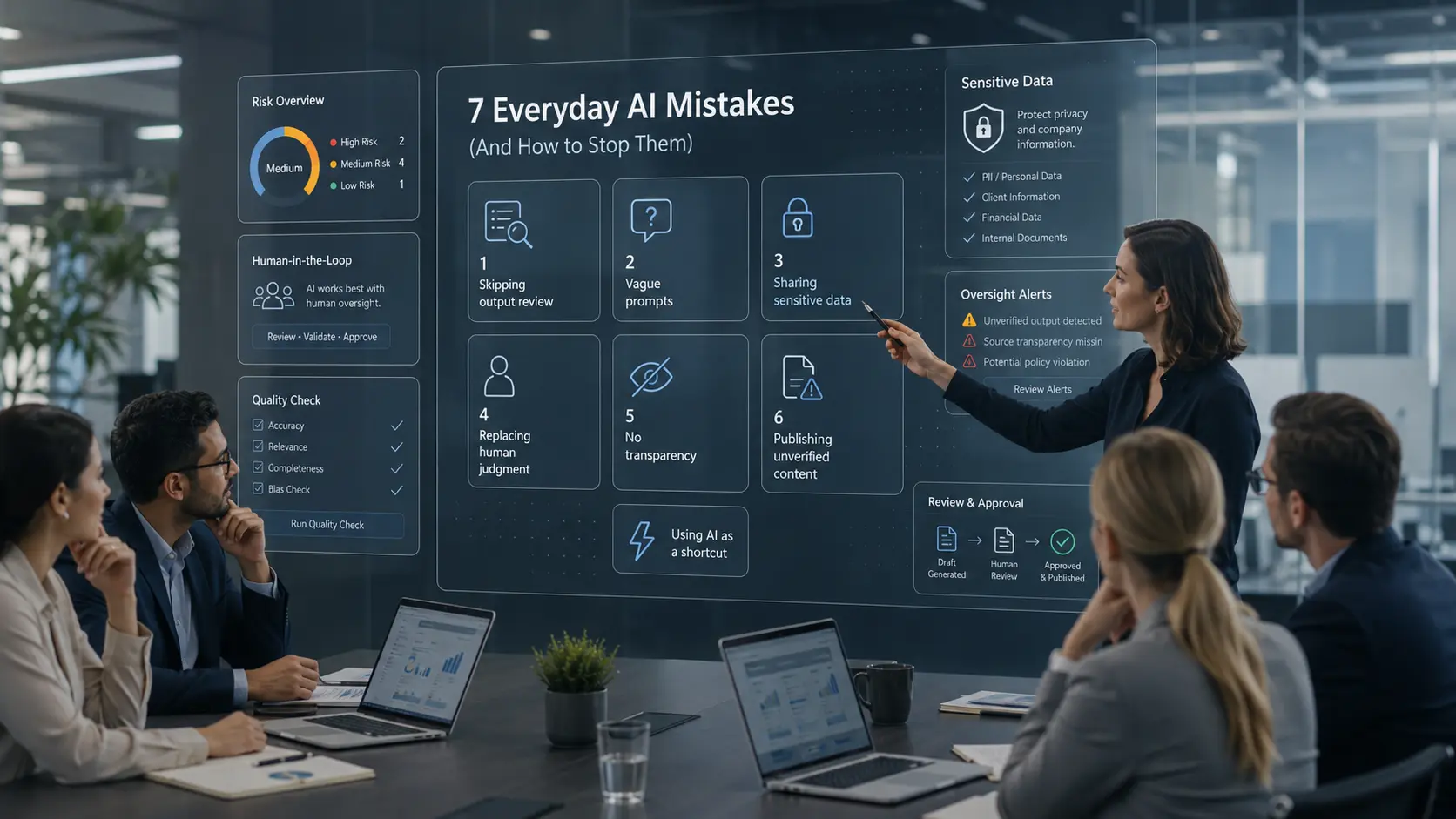
Before engaging with any AI tool, employees should know the foundations. And in 2026, the foundations are not complicated: don't use an AI tool without proper training, vet AI output before using it, prompt well, and understand the role of human experts in any AI-driven process. Does it sound like all of those are things every one of your employees would understand? Maybe you're lucky. Or maybe your training is unusually good.
For everyone else, the picture is messier. Most employees using AI at work aren't trying to cut corners or cause problems. They're trying to do their jobs faster and better. But good intentions and useful tools aren't the same thing as good outcomes. And the data on AI mistakes in the workplace makes that gap hard to ignore.
These aren't reckless employees. They're undertrained ones. The seven mistakes below are the patterns that appear most consistently across organisations and roles. Every one of them is preventable with the right habits and knowledge — none of which are difficult to build, and all of which are routinely skipped.
This is the most common mistake. And the one with the widest range of consequences. An employee asks an AI tool to draft an email, summarise a document, generate a report, or answer a question, then sends, submits, or acts on the result without reviewing it carefully.
The problem isn't that AI tools are unreliable. It's that they're unreliable in a specific way that makes the mistakes easy to miss. AI tools produce confident output. They don't flag their own errors, express uncertainty consistently, or signal when they've invented something plausible-sounding but wrong. The employee who skim-reads an AI-generated summary and forwards it is assuming a level of reliability the tool hasn't earned.
More than one in three workers rarely or only occasionally review AI-generated content before using it. The consequences range from embarrassing to expensive. A hallucinated product specification in a client proposal. An incorrect policy answer given to a customer. A financial figure that was never verified before appearing in a board report. None of these required the employee to do anything unusual. They just required them not to check.
Ask an AI tool a vague question and you'll get a vague answer. Ask it something specific — with context, a defined format, and a clear purpose — and the quality of the output improves substantially. Most employees who are dissatisfied with AI results are writing poor prompts — prompts that would produce a poor result from any capable colleague.
The difference is concrete. "Write me a summary of this report" produces a different result from "Write a three-paragraph executive summary of this report for a non-technical audience, focusing on the three main risk findings and the recommended action for each." The second prompt takes thirty seconds longer to write and produces a substantially more useful output. The tool hasn't changed. The instruction has.
The gap between a mediocre AI user and a skilled one isn't intelligence or technical knowledge. It's prompting discipline: the habit of giving the tool enough context to do what you actually need, rather than what you vaguely implied.
46% of employees have uploaded sensitive company data or intellectual property to public AI platforms. In most cases they're doing this to get work done faster: pasting, uploading, entering data — a client contract to get a summary, a dataset to get analysis, employee names and performance notes to draft a review. The intent is productivity. The consequence is a data transfer the organisation didn't authorise and can't reverse.
Public AI tools — consumer versions of ChatGPT, Claude, Gemini, and others — operate under different data terms from enterprise-licensed equivalents. Data entered into these tools may be used for model training, stored on servers in different jurisdictions, or simply outside the organisation's control entirely. Under GDPR and equivalent regulations, that transfer may constitute a breach requiring notification within 72 hours. Many client contracts also explicitly prohibit sending data to non-sovereign AI. The employee pasting the contract is potentially triggering both.
The reason this happens so frequently is straightforward: nobody told them. An employee who hasn't been trained on which tools are approved and what data can go into them is making their own judgment call every time. Most of the time they get away with it. Sometimes they don't.
AI tools are genuinely excellent at a specific category of tasks: drafting, summarising, reformatting, generating options, explaining concepts, and processing large volumes of text quickly. They're not good at tasks that require contextual human judgment — understanding the emotional subtext of a client relationship, assessing whether a colleague is struggling, deciding whether a situation needs escalation, or making a call that depends on organisational context the tool doesn't have access to.
The mistake isn't using AI for these tasks and getting a wrong answer. The mistake is using AI for these tasks and not recognising that the answer requires human verification before acting on it. A well-formatted AI response feels authoritative even when the judgment underpinning it is absent. A manager who uses an AI tool to assess whether a team member's performance warrants a formal conversation has outsourced the wrong judgment.
This mistake is different from the others. It isn't about how employees use AI. It's about what they don't know about how AI is being used on them.
80% of frontline workers report that their employers don't clearly communicate how AI is being used in their workplace. Scheduling decisions, performance flags, task assignments, and customer routing are all increasingly AI-influenced. And the employees on the receiving end of those decisions often have no idea. That matters for a specific practical reason: an employee who doesn't know their performance is being scored by an AI tool can't identify when the scoring is wrong, can't raise a concern through the right channel, and can't request a human review.
A warehouse operative whose hours have been cut by an AI demand forecasting tool, with no visibility into what drove the decision, has no way to flag that the model got their availability wrong. An employee whose AI-generated performance summary contains a data point from a different person's record has no way to dispute it if they don't know the summary was AI-generated. The problem isn't the AI. It's the absence of transparency.
This is a specific version of Mistake 1, but worth separating because the consequences are distinct. Employees using AI to generate external-facing content — marketing copy, client proposals, social media posts, reports for clients — frequently publish AI output with light or no editing. The result is content that may contain factual errors, hallucinated statistics, outdated information, or claims the organisation can't substantiate if challenged.
AI is very good at making content sound smooth. It isn't reliably good at making it accurate. The polished prose hides the problem, which is precisely what makes this mistake so consistent. A hallucinated statistic in a well-written paragraph reads better than an accurate one written hastily, which means the AI version often gets less scrutiny than the human version would have received. That's the wrong direction.
The practical risk is also legal. In several US jurisdictions, AI-generated statements in sales and marketing materials have been treated as actionable misrepresentations when companies couldn't substantiate the claims. The fact that an AI produced the claim isn't a defence.
This is the most subtle mistake on the list. And the one most employees wouldn't recognise in themselves. 64% of employees admit to putting less effort into their work knowing they can lean on AI. This isn't always laziness. It's often a rational response to time pressure, unclear expectations, or the genuine difficulty of a task. But the pattern it creates — using AI to produce something adequate rather than to help produce something good — is one of the clearest signals that AI is reducing rather than augmenting quality.
The distinction is between AI as a shortcut and AI as an accelerator. A shortcut produces acceptable output, less effort. An accelerator produces better output, same time. These look similar from the outside, especially when the AI's polished prose masks the difference in quality. They produce very different results over time — for the individual's skill development and for the organisation's output.
The employees most at risk here aren't the ones who distrust AI. They're the ones who have found that AI reliably produces something good enough, and have gradually stopped asking whether it's actually good.
All Seven Mistakes Share a Single Root Cause
Employees are using AI tools without the training to use them well. That isn't a criticism of employees. It's a description of the situation most organisations have created by deploying AI tools before building capability.
About half of employees use AI in the workplace without knowing whether it's allowed. More than four in ten are knowingly using it improperly. Those figures aren't a workforce problem. They're a training and governance problem. And they're entirely solvable. The compounding cost of leaving them unsolved is covered in AI adoption without AI training.
The employees who avoid these mistakes aren't more cautious or more technically sophisticated than the ones who make them. They're better trained. They know what the tools can and cannot do, what the organisational limits are, and what the right habits look like in their specific role and context. That knowledge isn't complicated. It just needs to be deliberately built — which is exactly what a complete AI training guide sets out.
It's practical training that builds the habits to avoid them. Savia's AI literacy programmes are built around exactly these scenarios — role-specific, applied, and designed to change behaviour rather than tick a box.